Timesheet (Extended View)
The Timesheet screen in the Extended view allows you to enter and manage the time worked on projects for a specific time period. Time is tracked by entering line entries on the timesheet to represent an area of a project, or a level of the project's WBS (work breakdown structure), and then entering the number of hours worked each day on it.
See Also: For information on the other available views for Timesheet, see Timesheet (Default View) and Timesheet (Simple View).
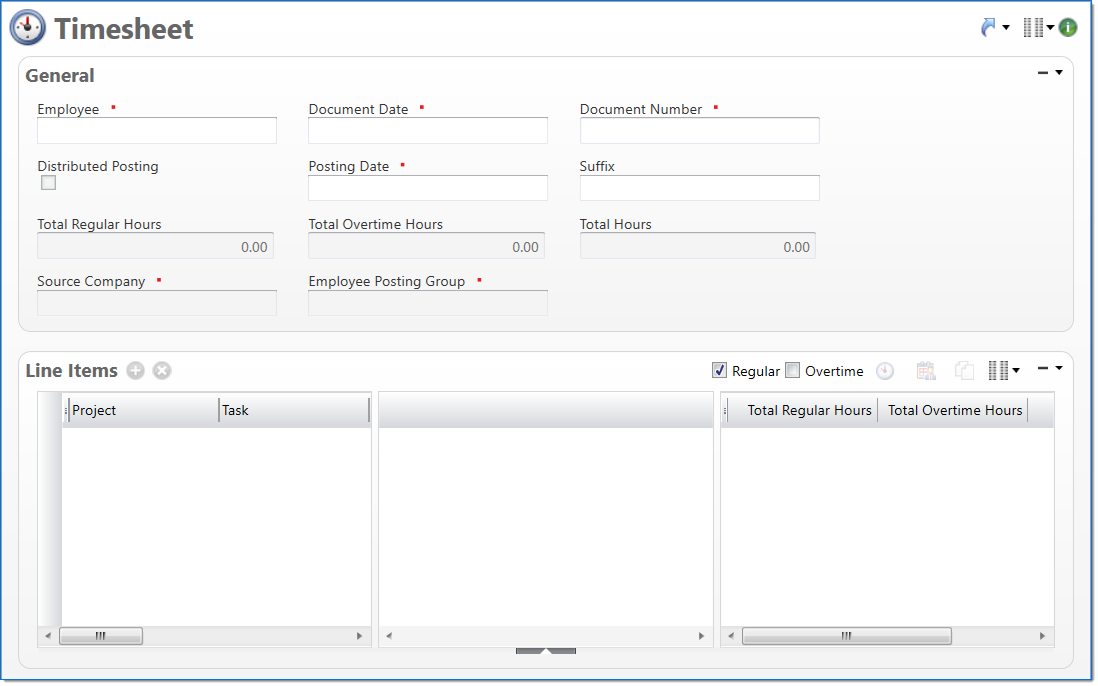
General
In the General area, enter general information about the timesheet.
| Field | Description | |
|---|---|---|

|
Employee |
Enter or select an active employee. This is the person that you are entering the timesheet for. |
|
|
Document Date |
Enter or select a document date when manually entering a timesheet. This date is used to organize timesheets in the system. Dates that may be selected are limited to posting dates where timesheets are Allowed and have been generated for the employee. The default is the first qualifying posting date that is greater than or equal to the current date. If the document date is changed, the actual date is reset to the first qualifying posting date (timesheets are Allowed and status is Open or Pending Close) that is greater than or equal to the entered document date. Also, the Line Items area is updated to reflect the new document date, which includes updated dates in the Hours section. Note: Document date is display only if it was created via a Timesheet Request, and it may not be changed. |

|
Document Number | Enter a unique document number to identify this document. This field automatically prepopulates and be read-only if an auto-counter has been defined for this type of document. |
|
|
Distributed Posting |
Select this to have the ability to split posting of a single timesheet to two different Posting Dates when a timesheet crosses a month end. The following rules apply for Distributed Posting:
When Distributed Posting is enabled and selected, you may deselect the checkbox with the following results:
|
|
|
Posting Date |
Enter or select the posting date. This date is used to associate the document with a posting period. The posting date must allow this document type as an input and its posting period must be in an Open or Pending Close stage. Note: If you enter the Document Date first, this field is automatically loaded! If this field is updated, the Document Number field is updated to the selected employee's code plus the Posting Date. |
| Suffix |
Enter or select any active input document suffix that is available for the current document type. This can be used in reports to select or sort documents. |
|
| Source | Select the type of Document. This is Timesheet unless the timesheet was spawned by another document type. | |
| Total Regular Hours | Displays the sum of regular hours from the line items. | |
| Total Overtime Hours | Displays the sum of overtime hours from the line items. | |
| Total Hours | Displays the sum of regular and overtime hours from the line items. | |
|
|
Source Company |
Enter or select an active company. This determines if the timesheet involves intercompany transactions. |
|
|
Employee Posting Group | Displays the posting group assigned to the employee. This determines the liability accounts. The default is the posting group of the selected Employee. |
Line Items
In the Line Items area, add rows to enter information about the hours that were worked. The area is divided into three main sections, which include project WBS, hours, and totals data.
| Field | Description | |
|---|---|---|
| Regular | Select this option to enter regular hours for each date in the Hours section. When both this and the Overtime option is selected, each date is divided into two columns to allow for data entry. | |
| Overtime | Select this option to enter overtime hours for each date in the Hours section. When both this and the Regular option is selected, each date is divided into two columns to allow for data entry. | |
| Load Previous Timesheet |
Click the Load Previous Timesheet
|
|
| Load Employee Assignments Button |
Click the Load Employee Assignments The total scheduled hours are also included. |
|
| Project WBS |
The Project Work Breakdown Structure section allows you to enter lines of project details to use to charge time against on the timesheet. For each line, select a Project, Task, Company, Organization, Labor Bill Class, Activity Type, and an Hours Type. For a detailed description of these fields, see |
|
| Hours |
The Hours section allows you to enter the number of hours you worked on each line entry each day. The displayed dates are based on what has been defined for the selected Document Date. Above the Line Items grid, there are Regular and Overtime options, which allows you select the type of hours you are entering on the grid. When both options are selected, each date is divided into two columns to allow for data entry. A description can be added to an hours cell once a number of hours has been added. This description is available throughout the lifecycle of a timesheet and in project reporting. When a description is added to an hours field, a red marker is added to the top, right-hand corner of the cell. For more information, see Add and View Time Descriptions. A total of the hours entered per day is displayed on the bottom line of the grid. |
|
| Totals |
The Totals section displays the number of Total Regular Hours, Total Overtime Hours, Total Hours, and Scheduled Hours for each line item. The totals are updated as you enter information on your timesheet. The Scheduled Hours column displays the published scheduled hours, which allows employees to track how they are doing against the schedule. A total of each column is displayed on the bottom line of the grid. |
|
 button to populate the line items grid with the line items from the employee’s previous timesheet (most recent timesheet prior to the current one, based on Document Date). Copy constraints are:
 button to populate the line items grid with the current project / task assignments for you or the selected employee. A new line item is added for each project / task combination assigned in Resource Scheduling that does not already exist on the timesheet.
 WBS Column Descriptions